
You probably know the chorus of Percy Montrose – Clementine, also called Oh My Darling Clementine. But how did a song about a miner’s daughter become such a familiar sing-along? Behind that easy melody sits a drowning, a helpless narrator, and a streak of humor that makes the story stranger than its opening suggests.
Percy Montrose and the 1884 publication
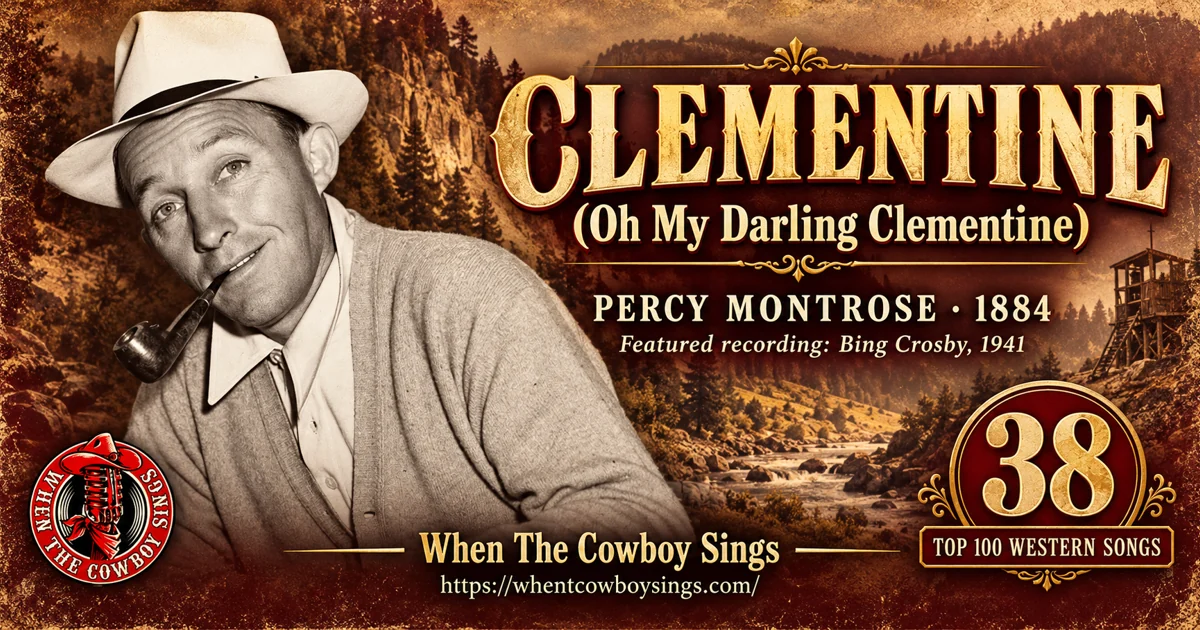
The Morgan Library & Museum catalogs an 1884 first edition of Oh, My Darling Clementine, credited to Percy Montrose and published in Boston by Oliver Ditson. It is scored for voice, chorus, and piano. That gives us a documented publication, rather than an original record release: this song belongs to the era before commercial recordings shaped the music business.
The familiar ballad is usually credited to Montrose, but its earlier roots and authorship have attracted competing explanations. It is safer to distinguish that documented edition from claims that one person invented every part of the song. Here, Montrose is identified as the credited writer, not as a recording artist.
The story behind Oh My Darling Clementine
Clementine is the daughter of a forty-niner, placing the narrative in the world of the California Gold Rush. She falls into the water, and the narrator cannot save her because he cannot swim. The repeated chorus sounds like an uncomplicated expression of grief, yet the exaggerated descriptions and comic turns in familiar versions complicate that reading.
That uneasy balance is part of the song’s appeal. A performer can emphasize the sadness, lean into the absurdity, or let both feelings exist together. The setting also gives it a natural home alongside the frontier stories preserved in Western music.
A Western song beyond one recording
The song was already being collected outside the commercial recording studio before Bing Crosby’s version. The Library of Congress preserves John McCready singing it unaccompanied in Groveland, California, on August 2, 1939. That field recording documents the song as part of a living singing tradition.
For the listening selection below, we have chosen Bing Crosby’s 1941 recording with the Music Maids and Hal, accompanied by John Scott Trotter’s orchestra. His playful treatment offers a different way into the old ballad; it should not be mistaken for Montrose’s original performance.
No. 38 among the Top 100 Western Songs
Clementine occupies No. 38 in the Western Writers of America list reproduced by Dave’s Music Database. That position belongs to the song, regardless of who performs it. Continue exploring our Top 31–40 Western songs, or listen below and notice how Crosby changes the mood of a chorus so many people recognize.